
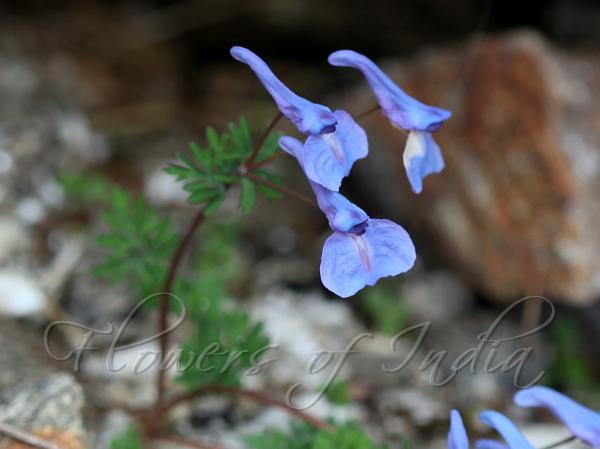
| East-Himalayan Blue Corydalis |

|
 |

|


| File size | 377424 |
| Original date | 7/1/25 3:19 PM |
| Resolution | 2048 x 1536 |
| Flash | Flash did not fire, auto |
| Focal length | 100.0mm |
| Exposure time | 1/200s |
| Aperture | 4.0 |
| Focus Distance | |
| Metering Mode | Multi-segment |
| Camera make | Canon |
| Camera model | Canon EOS 5D Mark II |
| Sensor type |
 |
 ative ative |
 |
 |
 |
Photo: |
Botanical name: Corydalis ecristata Family: Papaveraceae (Poppy family)
Synonyms: Corydalis cashmeriana var. ecristata, Corydalis cashmeriana var. brevicornu
Synonyms: Corydalis cashmeriana var. ecristata, Corydalis cashmeriana var. brevicornu
East-Himalayan Blue Corydalis is a perennial herb,
5-10 cm above soil surface; stems and leaf-stalks of radical leaves are
narrowed to thread-like underground base. Flowers are clear blue,
inner petals pale but darker at tip; upper petal narrowly boat-shaped,
1.3-1.9 cm, somewhat pointed, crest narrow or absent. Spur is straight
or downcurved at tip, cylindric, 6-11 mm; nectary about 2/3 as long as
spur; lower petal 1-1.3 cm, claw distinct, 4-5 mm, limb round, much
surpassing upper petal, 7-10 mm wide, tip flat; inner petals 7-9 mm.
Flower-stalk 8-25 mm, thin, erect in fruit, sepals minute. Flowers are
borne in umbel-like raceme, 1-3 cm, 2-6-flowered, not elongating in
fruit; bracts 8-13 mm, deeply cut into 3-13 linear lobes. Stems are
erect, thin, simple, with 1 leaf in upper 1/3, or leaf lacking. Radical
leaves are few; leaf-stalk 2-6 cm, thin; blade 6-15 x 8-15 mm,
bi-(tri-)ternate, primary leaflets petiolulate, ultimate leaflets
stalkless, deeply divided into obovate to elliptic lobes. Stem leaf
stalkless. East-Himalayan blue corydalis is found on mossy rocks, fine
scree, at altitudes of 4000-5000 m, in NE Nepal to NW Arunachal Pradesh
and S Tibet. Flowering: June-September.
| Identification credit: Ed Shaw | Photographed in Sela Pass, Arunachal Pradesh. |
• Is this flower misidentified? If yes,